Product sampling works. Everyone knows this.
What most e-commerce brands don't realize is how easy it is to do sampling intelligently—targeting the right customers with the right samples at the right time, and measuring the results.
The old way: throw samples in every box and hope for the best.
The better way: add samples based on customer behavior, track who converts, and optimize.
This guide shows you how.
Let's start with the data:
But here's what makes e-commerce sampling different from in-store:
This turns "spray and pray" sampling into measurable marketing.
Before picking what to sample, understand the difference:
| Strategy | Definition | Sample Example |
|---|---|---|
| Cross-sell | Selling a different product category | Coffee buyer → Tea sample |
| Upsell | Selling a more expensive version | Small coffee → Large coffee discount card |
Both work, but they serve different goals:
This guide focuses on cross-sell sampling because it's where e-commerce brands leave the most money on the table.
Not every customer should get a sample. The best targets are:
Example: A customer who buys coffee regularly but has never ordered tea is the perfect target for a tea sample. They trust your brand (they keep buying), but they haven't explored your full product line.
Here's how to implement smart sampling with Insertr.
In Shopify Admin:
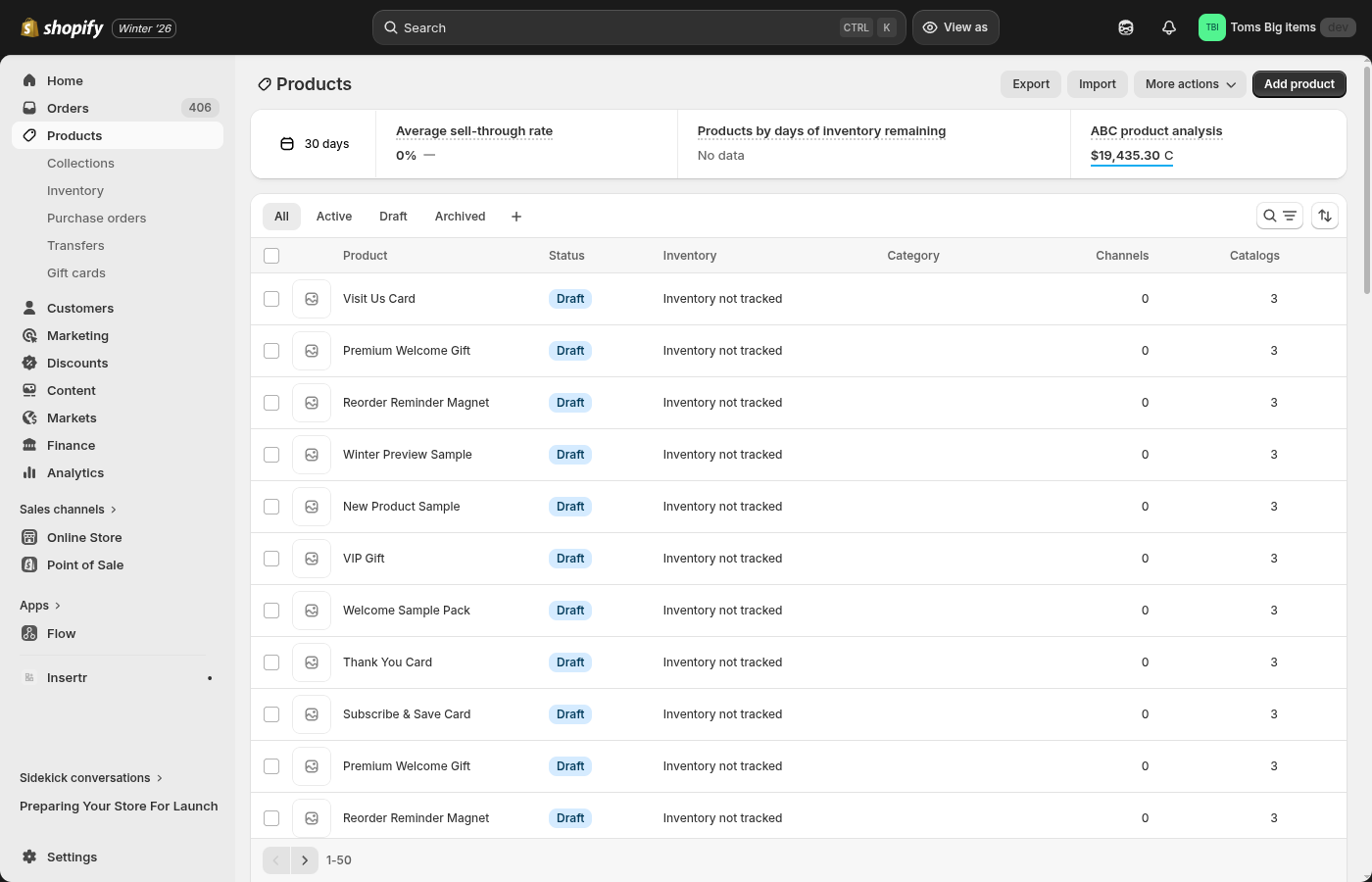 Set up your sample as a regular product with a clear SKU.
In Insertr, create a rule that targets your ideal customer:
Rule: "Coffee → Tea Cross-Sell Sample"
Conditions (ALL must match):
| Condition | Setting | What it checks |
|---|---|---|
| Customer Has Ordered Product Tag | coffee (checked) |
Have they bought coffee before? |
| Customer Has Ordered Product Tag | tea (NOT checked) |
Have they bought tea before? No = good |
| Order Contains Product Tag | tea (NOT checked) |
Is tea in this order? No = good |
Settings:
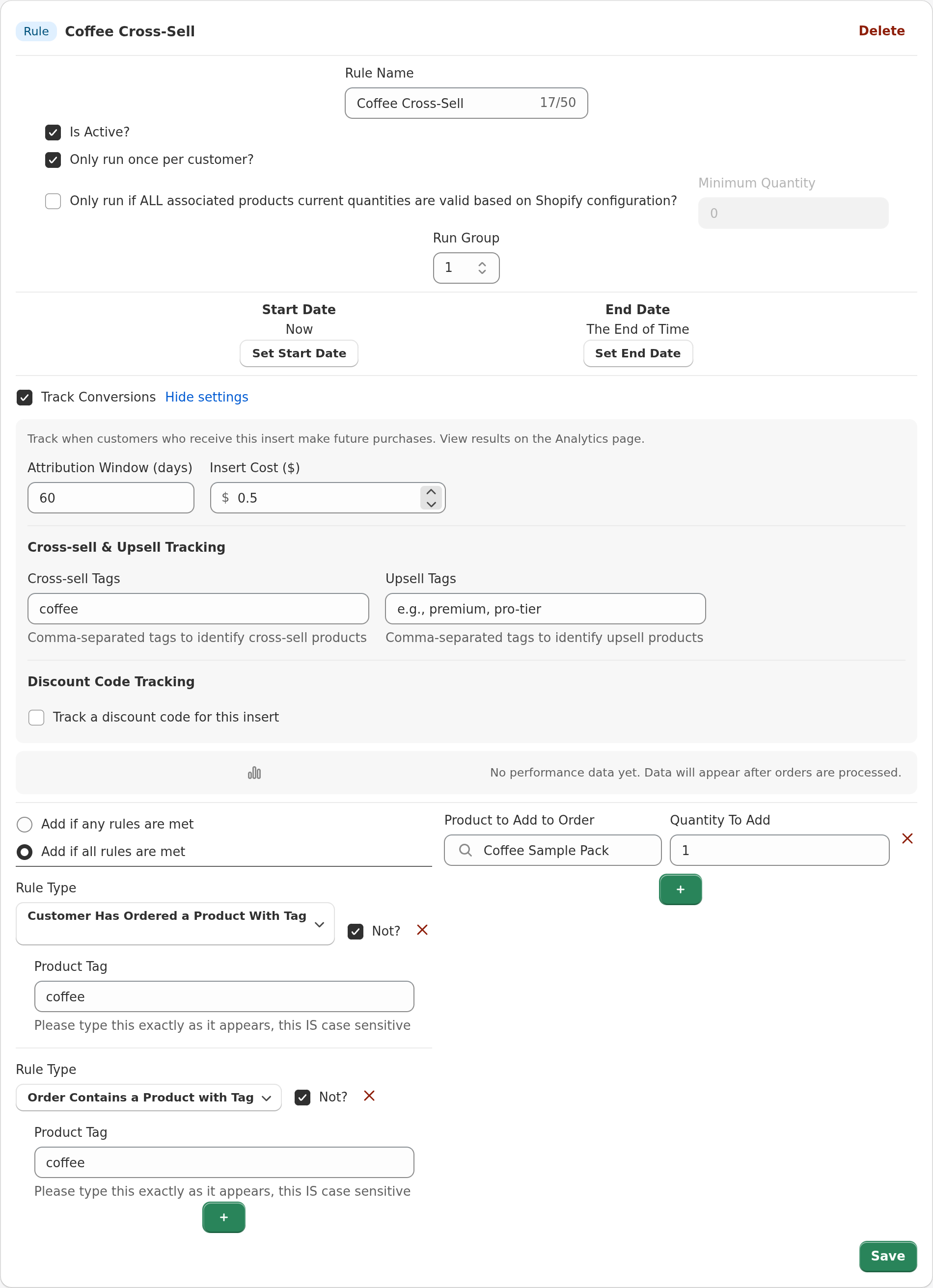 The rule targets coffee buyers who've never purchased tea and aren't buying it now.
Why this works:
Enable conversion tracking to measure sample effectiveness:
tea (products you want to track)Now Insertr will track when tea sample recipients later purchase tea products.
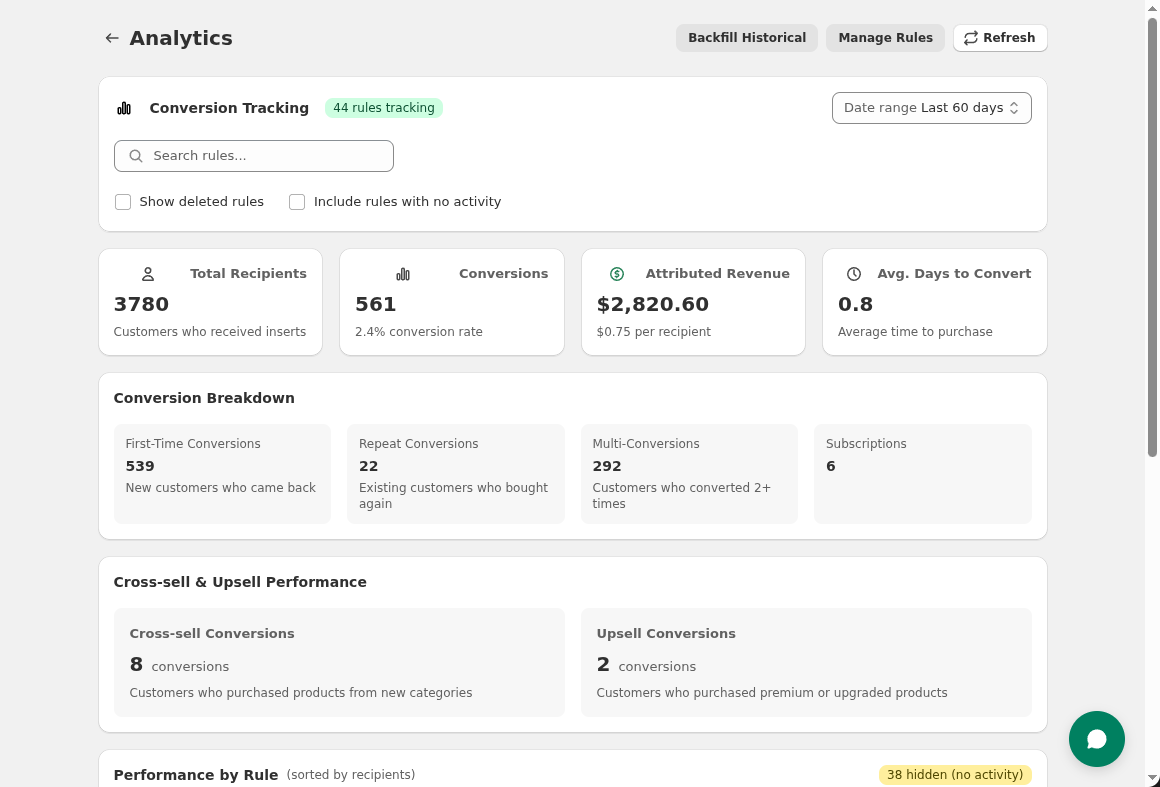 See conversion rate from sample recipients to tea purchasers.
Product sampling isn't free. You need to know if it's working.
| Metric | How to Calculate | Target |
|---|---|---|
| Conversion Rate | Tea purchases ÷ Tea samples sent | 10-15% |
| Revenue per Sample | Tea revenue from converters ÷ Total samples | > Sample cost |
| ROAS | Revenue ÷ (Sample cost × Samples sent) | > 3x |
Let's say:
Total investment: $2.00 × 500 = $1,000 Total revenue: 60 × $35 = $2,100 ROAS: $2,100 ÷ $1,000 = 2.1x
Is 2.1x good? It depends on your margins. But this is measurable, unlike most sampling programs.
Track cost, revenue, and ROAS for each sampling rule.
Not sure which sample converts better? Test it.
Instead of a regular rule, create an A/B test:
A/B Test: "Sample Test: Tea vs Matcha"
Variants:
Same conditions as before:
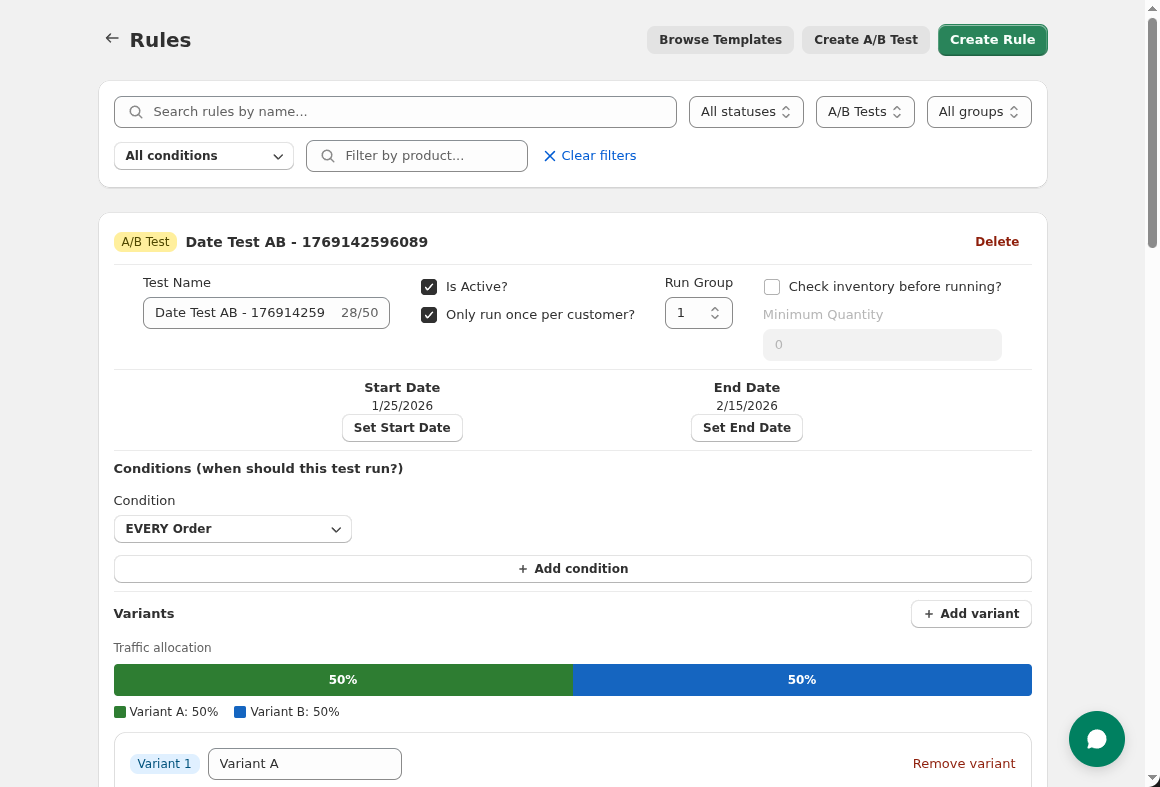 Split test different samples to find what converts best.
After enough orders (aim for 100+ per variant), compare:
| Variant | Recipients | Conversions | Rate | Revenue |
|---|---|---|---|---|
| Tea Sample | 150 | 18 | 12% | $630 |
| Matcha Sample | 148 | 22 | 15% | $1,100 |
In this example, Matcha converts better AND drives higher revenue (matcha is premium-priced). Roll out matcha as your default sample.
Pattern: Buyer of Category A → Sample of Category B
Examples:
Best for: Brands with multiple product categories where customers tend to stick to one.
Pattern: Buyer of Product X → Sample of related Product Y
Examples:
Best for: Products where flavor/scent preference matters. Let customers discover new favorites.
Pattern: Loyal customer → Sample of new product
Examples:
Best for: Getting initial traction and reviews on new SKUs. Loyal customers are most likely to try and review.
Pattern: Summer buyer → Winter preview sample
Examples:
Best for: Extending customer lifetime across seasons. Prevents "summer-only" customer churn.
For high-value categories, consider a sampling sequence:
Stage 1: Free sample in order Stage 2: If they don't convert in 30 days, email reminder Stage 3: If still no purchase, "last chance" offer with small discount
This combines physical and digital touchpoints for maximum conversion.
Q: Should I sample my best-seller or a niche product? A: Start with best-sellers. Higher chance of conversion, more representative data. Test niche products after you've proven the model works.
Q: How much sample is enough? A: Enough to evaluate the product, not enough to replace a purchase. For consumables, 1-3 servings is typical.
Q: What if my samples are expensive? A: Either:
Q: Will sampling cannibalize sales? A: Unlikely if you target non-buyers. Someone who was going to buy tea anyway probably wouldn't qualify (they'd have tea in their order or purchase history).
Let me share how this worked at Cool Steeper Club, the tea subscription box I founded before building Insertr.
The situation: We noticed customers who bought our cold brew tea often asked about our coffee-alternative products, but rarely crossed over on their own.
The experiment: We added a coffee-alternative sample to cold brew orders for customers who'd never bought from that category.
The results:
This experience directly influenced how Insertr's cross-sell tracking works.
Ready to turn samples into a growth channel?
Stop guessing which samples work. Start measuring.
Last updated: January 2026 | Author: Tom McGee, Founder of Insertr
About the Author: Tom McGee is the founder of Insertr and a former Senior Software Engineer at both Shopify and ShipBob. He founded Cool Steeper Club, a curated cold brew tea subscription box, where he used product sampling to drive cross-category expansion—learning firsthand which sampling strategies convert.