You spend money getting customers to your store. You craft emails that mostly go unread. You run ads that compete with every other brand.
But there's one touchpoint where you have zero competition and 100% attention: the moment your customer opens their package.
That's why thank you cards work. Not as a quaint nice-to-have, but as a measurable marketing channel.
Here's what the data says:
A thank you card that costs $0.50 can turn a one-time buyer into a repeat customer. This guide covers 15 ideas for every stage of the customer journey—with examples you can implement today.
Before diving into specific ideas, let's cover the basics of effective thank you card copy.
Keep it short. You have 3-5 seconds of attention. Get to the point.
Make it personal. Use the customer's first name if possible. Reference their purchase.
Include one clear action. Don't ask for a review AND a referral AND a social follow. Pick one.
Sound human. Skip the corporate speak. Write like you're thanking a friend.
Simple appreciation:
"Thank you for supporting our small business. Every order helps us do what we love. — The [Brand] Team"
With discount code:
"Thanks for your order! Here's 15% off your next purchase: THANKYOU15. Use it before [date]."
Founder note:
"Hi [Name], I started [Brand] in my garage in 2019. Your order today means the world. Thank you. — [Founder Name]"
Review request:
"Enjoying your [Product]? We'd love to hear about it. Scan the QR code to leave a quick review."
Now let's look at 15 specific thank you card strategies, organized by when to use them.
The first order is your one chance to make a memorable impression. These cards turn first-time buyers into repeat customers.
What it is: A card that looks handwritten (printed, but with a script font and personal tone) welcoming the customer to your brand.
What to write:
"Welcome to [Brand]! We're so glad you found us. Your order was packed with care by [Name]. If you ever need anything, just reply to this email—we actually read them all."
Why it works: Creates an emotional connection. Feels personal even at scale.
Insertr setup:
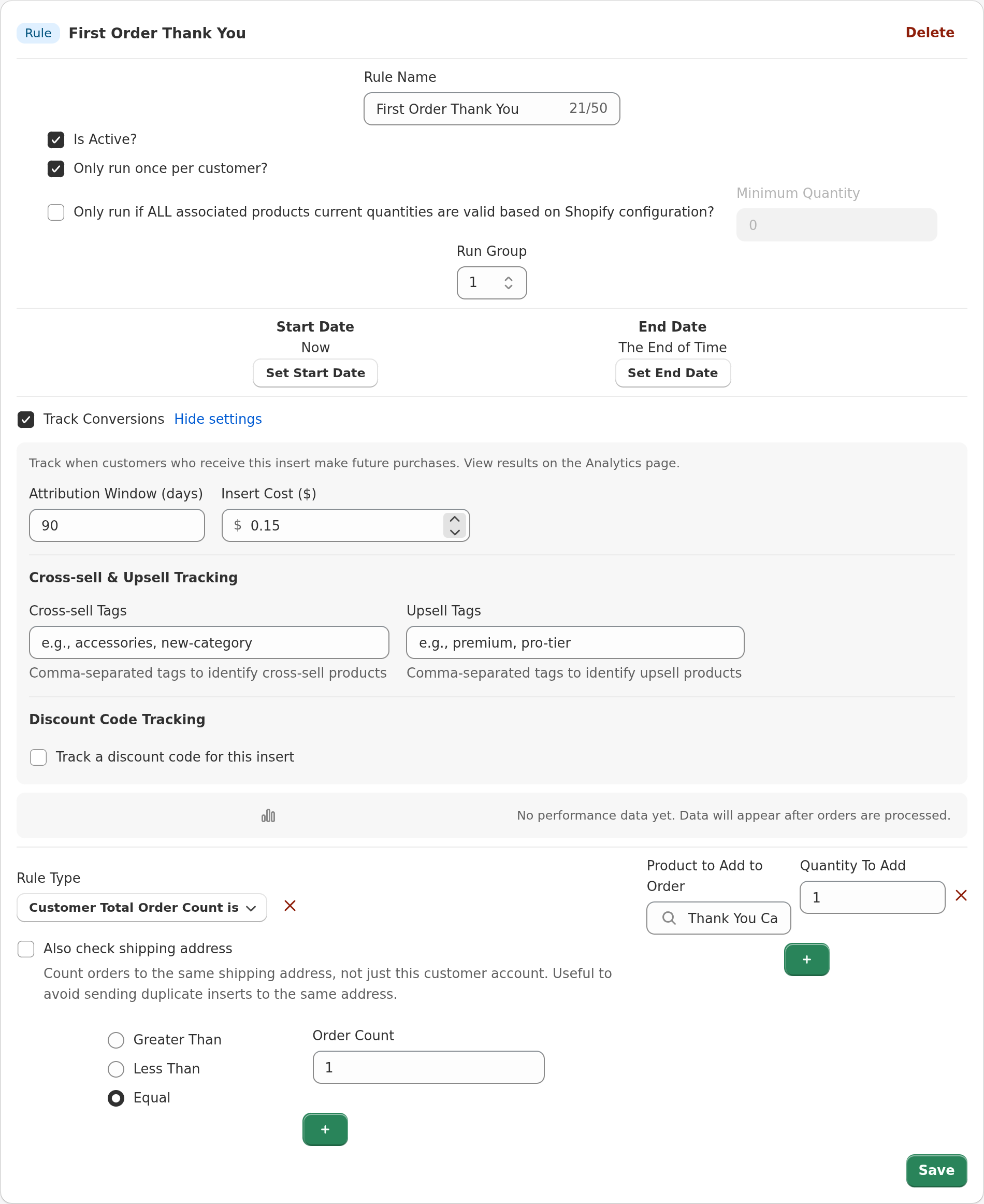 Set the order count condition to "Equal to 1" to target first-time buyers.
What it is: A postcard-sized card with a brief founder story and photo.
What to write:
"Hi, I'm [Name]. I started [Brand] after [brief origin story]. Thank you for being part of this journey."
Why it works: People buy from people. Seeing the founder's face and story builds trust and emotional investment in your brand's success.
Best for: Small brands where the founder story is compelling. DTC brands competing against faceless corporations.
What it is: A card with a QR code linking to a short video thank you from the founder or team.
What to write:
"Scan for a personal thank you from our team."
Why it works: Video creates deeper connection than text. Customers feel like they know you. The QR code bridges physical to digital without typing URLs.
Pro tip: Keep the video under 30 seconds. Thank them, show a quick behind-the-scenes of packing, invite them to follow on social.
What it is: A discount card with a short expiration window (7-14 days).
What to write:
"Thanks for your first order! Here's 15% off your next purchase. Expires in 14 days. Use code: WELCOME15"
Why it works: Urgency drives action. New customers who don't return within 30 days rarely come back at all. This nudges them before you lose them.
Insertr setup:
Reward your best customers and make them feel valued.
What it is: A thank you card (often with a small gift) when customers hit spending milestones like $500 total or their 10th order.
What to write:
"You've been with us since the beginning. Thank you for $500+ in support. Here's a little something just for you."
Why it works: Recognition makes customers feel special. VIP treatment increases loyalty and word-of-mouth.
Insertr setup:
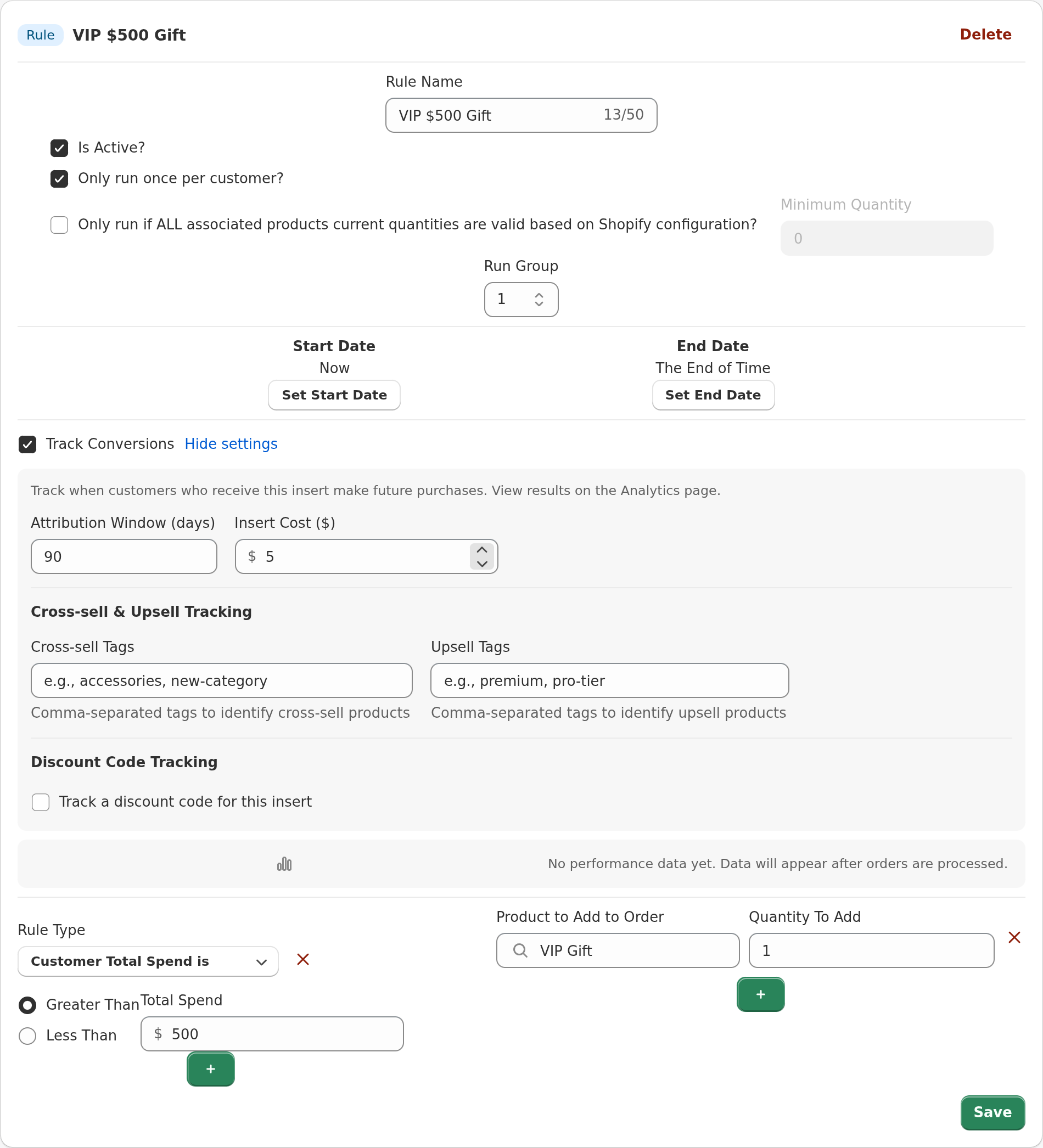 Target high-value customers who've spent over a threshold amount.
What it is: A card recognizing the anniversary of a customer's first purchase.
What to write:
"It's been one year since your first order! Thank you for sticking with us. Here's 20% off to celebrate: ONEYEAR20"
Why it works: Personalized timing stands out. Shows you pay attention. Anniversary discounts have high redemption rates.
Note: This requires date-based triggering which may need external automation, but you can approximate with order count rules.
Tailor your thank you based on what the customer bought.
What it is: A card with tips for getting the most out of the specific product they purchased.
What to write:
"Pro tip: For best results, use [Product] with [complementary product or technique]. Questions? Email us anytime."
Why it works: Increases product satisfaction. Reduces returns. Shows you care about their experience, not just the sale.
Insertr setup:
What it is: A card with recipes, styling ideas, or creative uses for the product.
What to write:
"Try this: [Recipe or idea using the product]. Share your creations with #[YourHashtag]"
Why it works: Adds value beyond the product. Encourages social sharing. Works especially well for food, beauty, and craft products.
What it is: A card explaining how to care for, store, or maintain the product.
What to write:
"Keep your [Product] looking great: [Care instructions]. Need help? Text us at [number]."
Why it works: Reduces support tickets. Extends product life. Shows attention to detail.
Time your thank you cards to seasons and events.
What it is: A festive thank you card included with orders during holiday seasons.
What to write:
"Happy holidays from our small business to your home. Thank you for making 2026 our best year yet."
Why it works: Holiday orders are often gifts. A nice card reflects well when the gift is opened. Seasonal touches feel special.
Pro tip: Order holiday cards early—printing gets backed up in November.
What it is: A "New Year, New Order" discount card included with December/January orders.
What to write:
"Start 2026 right. Here's 20% off your next order. Valid through January 31. Code: NEWYEAR20"
Why it works: New Year resolutions drive purchase intent. A physical reminder beats an email that gets buried.
Thank you cards that directly drive measurable outcomes.
What it is: A card asking customers to leave a review, with a QR code to your review page.
What to write:
"Loving your [Product]? A quick review helps other customers find us. Scan to leave yours—it takes 30 seconds."
Why it works: Reviews drive conversions. Physical cards have higher engagement than email review requests. QR codes remove friction.
Pro tip: Don't offer incentives for reviews—it violates most platform policies. A genuine ask works.
What it is: A card encouraging customers to share their purchase on social media.
What to write:
"Share your unboxing! Tag us @[YourHandle] and use #[YourHashtag] for a chance to be featured."
Why it works: User-generated content is free marketing. Customers trust other customers. Features build community.
What it is: A card with a unique referral code or link the customer can share with friends.
What to write:
"Love [Brand]? Share this card with a friend. They get $10 off, you get $10 credit. Win-win."
Why it works: Referrals have higher lifetime value than other acquisition channels. Physical cards get passed along more than emails.
Insertr setup:
What it is: A card promoting your subscription option to one-time buyers.
What to write:
"Love [Product]? Subscribe & save 15%. Never run out, cancel anytime. Scan to set up auto-delivery."
Why it works: Subscription revenue is predictable. Customers who need reminders to reorder will appreciate the convenience.
Insertr setup:
Manually adding cards to orders doesn't scale. Here's how to automate with Insertr:
No special integration needed. No per-order manual work.
Not all thank you cards perform equally. Here's how to measure:
If your card includes a discount code, track redemptions:
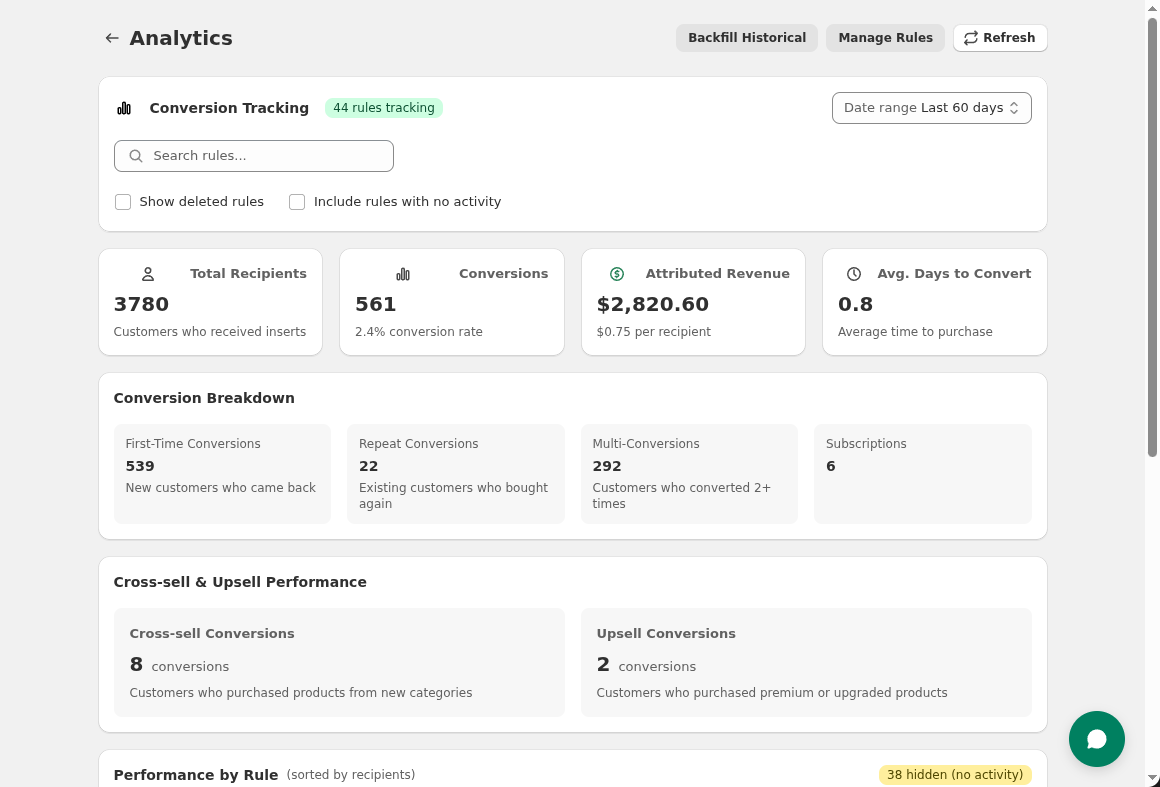 See how many recipients redeemed your printed discount code.
You'll also see non-recipient redemptions—customers who used the code but never received the card. This reveals code sharing, which can be good (word of mouth) or bad (code leaks to coupon sites).
Track whether card recipients make repeat purchases:
Conversion tracking shows how many recipients came back to buy again.
Compare conversion rates across different card types to find what drives the most repeat business.
Quality paper stock matters. A flimsy card feels cheap. Invest in decent cardstock.
Keep it simple. One message, one action. Don't cram multiple asks onto one card.
Include your logo but don't dominate. The message matters more than branding.
Make codes large and legible. Customers shouldn't struggle to read "WELCOME15".
Test before printing thousands. Order a small batch first.
Q: Won't customers think it's weird to get a $0 item? A: Most don't notice or don't care. You can customize Shopify email templates to hide $0 items if it bothers you.
Q: How much should I spend on thank you cards? A: $0.25-$1.00 per card is typical. High-quality cards cost more but create better impressions. Calculate ROI based on repeat purchase rate.
Q: Should every order get a thank you card? A: Not necessarily. First orders and VIP milestones have the highest impact. Too many cards can feel spammy.
Q: What size works best? A: 4"x6" postcards are standard. Business card size for simple messages. A6 folded cards for premium feel.
Ready to turn thank you cards into a growth channel?
Your customers are already opening your packages. Make that moment count.
Last updated: January 2026 | Author: Tom McGee, Founder of Insertr
About the Author: Tom McGee is the founder of Insertr and a former Senior Software Engineer at both Shopify and ShipBob. He founded Cool Steeper Club, a curated cold brew tea subscription box, where he used package inserts to drive subscriber retention and learned firsthand which thank you card strategies actually work.