Acquiring a customer costs 5-7x more than retaining one.
Yet most e-commerce brands pour resources into acquisition and treat post-purchase as an afterthought. A generic confirmation email. A tracking link. Maybe a review request.
The result: one-time buyers stay one-time buyers.
This guide covers how to create a post-purchase experience that converts first-time customers into repeat purchasers—and repeat purchasers into brand advocates.
What Makes a Great Post-Purchase Experience?
The post-purchase experience encompasses everything from checkout to (potential) next purchase. It's evaluated across four dimensions:
1. Communication
Customers want to know what's happening with their order. Silence creates anxiety.
Good communication:
- Order confirmation immediately
- Shipping notification with tracking
- Delivery notification
- Proactive updates if delays occur
Great communication:
- Personalized messages ("Hi Sarah, your order...")
- Clear expectations ("Ships tomorrow, arrives Wednesday")
- Helpful content alongside updates (product tips, FAQ answers)
- Branded tracking pages (not just carrier defaults)
2. Speed
Customers have been trained by Amazon Prime. Two days feels slow now.
Speed factors:
- Processing time (order to shipment)
- Transit time (shipment to delivery)
- Perceived speed (how it feels regardless of actual days)
You can't always control transit, but you can:
- Ship fast (same-day or next-day processing)
- Set accurate expectations (under-promise, over-deliver)
- Keep customers informed (waiting feels shorter with updates)
3. Packaging
The unboxing moment is the physical manifestation of your brand. It's the first time the customer touches your company.
Basic packaging:
- Product arrives undamaged
- Plain brown box, minimal presentation
Good packaging:
- Branded elements (tissue paper, tape, box)
- Product positioned intentionally
- Clean, professional presentation
Great packaging:
- Thoughtful presentation that feels like a gift
- Inserts that add value (thank you card, tips)
- Personal touches that exceed expectations
4. Surprise and Delight
Exceeding expectations creates memories—and memories drive loyalty.
Surprise elements:
- Unexpected gift or sample
- Handwritten-style note
- Faster delivery than estimated
- Higher-quality packaging than expected
- Small upgrade or bonus
Surprise doesn't need to be expensive. A $0.50 thank you card can create disproportionate goodwill.
The Post-Purchase Experience Timeline
Phase 1: Immediate (0-2 hours post-purchase)
What happens: Customer receives order confirmation.
Customer mindset: Relief that order went through. Beginning of anticipation. Possible buyer's remorse lurking.
What to do:
- Send confirmation email immediately (not 30 minutes later)
- Include clear order details (what, when, how much)
- Set shipping expectations ("Ships within 24 hours")
- Express gratitude briefly and authentically
- Provide easy access to support if needed
Common mistakes:
- Delayed confirmation creates anxiety
- Long, dense emails that bury important info
- Immediate upsell attempts (read the room—they just bought)
- No clear timeline for next steps
Phase 2: Anticipation (1-5 days)
What happens: Order is processed and shipped. Customer waits.
Customer mindset: Anticipation builds. Tracking obsession begins. "Where is it?"
What to do:
- Send shipping notification with tracking link
- Consider a branded tracking page
- Send delivery day notification
- Be proactive about any delays (don't let them find out via tracking)
Common mistakes:
- No shipping notification
- Carrier tracking only (missed branding opportunity)
- No delivery day heads-up
- Delays without explanation
Phase 3: Delivery (The Peak Moment)
What happens: Package arrives. Customer opens it.
Customer mindset: Highest positive emotion. Dopamine release. Judgment time.
This is where physical experience matters most.
What to do:
- Package professionally (presentation counts)
- Include something unexpected (thank you card, sample)
- Make the product easy to access
- Include relevant documentation (instructions, care guide)
- Consider branded elements that photograph well (for UGC)
Common mistakes:
- Product loose in oversized box
- Excessive hard-to-open packaging
- Nothing but product and packing slip
- Documentation missing or generic
Insert opportunity: Maximum impact. Customer is receptive and positive.
Phase 4: First Use (1-7 days post-delivery)
What happens: Customer uses the product.
Customer mindset: Forming opinions. Does this match expectations?
What to do:
- Send a check-in email (timing based on product)
- Provide tips for getting the most from the product
- Make support easily accessible
- Don't overwhelm with sales messaging yet
Common mistakes:
- Radio silence until review request
- Immediate "buy more" emails
- No support visibility if something's wrong
Phase 5: Integration (7-30 days)
What happens: Product becomes part of routine (or doesn't). Long-term satisfaction crystallizes.
Customer mindset: Settling into opinion. Brand affinity forming.
What to do:
- Request a review (at the right time)
- Share relevant content (styling ideas, recipes, tips)
- Introduce complementary products gently
- Celebrate if they make another purchase
Common mistakes:
- Review request too early (before they've properly used it)
- Review request too late (enthusiasm faded)
- Hard-sell follow-ups that feel pushy
Phase 6: Decision Window (14-60 days)
What happens: Customer decides whether to buy again.
Customer mindset: Considering next purchase (or not). Influenced by total experience.
What to do:
- Have inserts that persist (magnet, card on desk)
- Time-appropriate reorder nudges (for consumables)
- Relevant recommendations based on purchase
- Loyalty recognition if repeat customer
This is when insert ROI materializes: the discount card they kept, the magnet on the fridge.
Personalization: The Key to Great Experiences
Generic experiences feel like transactions. Personalized experiences feel like relationships.
Personalization Levels
Level 0: No personalization
- "Dear Customer"
- Same insert for everyone
- Generic follow-up sequence
Level 1: Basic personalization
- Uses customer name
- References their purchase
- Timing based on when they ordered
Level 2: Segment personalization
- Different treatment for new vs. returning
- VIP customers get VIP experience
- Segment-specific messaging
Level 3: Individual personalization
- Recommendations based on their history
- Inserts relevant to what they bought
- Communication style matching their preferences
Most brands operate at Level 0-1. Level 2 is achievable with automation. Level 3 is the goal.
Segmenting Your Post-Purchase Experience
Create distinct experiences for different customer types:
| Segment |
Identification |
Experience Strategy |
| First-time buyer |
Order count = 1 |
Welcome focus. Reduce remorse. Encourage return. |
| Returning customer |
Order count = 2-5 |
Recognition. Deeper engagement. Expand relationship. |
| VIP customer |
Total spend > $500 |
Premium treatment. Exclusivity. High-touch. |
| Subscriber |
Has active subscription |
Retention focus. Milestone celebration. |
| At-risk |
90+ days since last order |
Re-engagement. Win-back incentive. |
Case Study: Building a Segmented Insert Strategy
Context: A skincare brand with 3,000 orders/month wants to personalize their post-purchase experience.
Segment 1: New Customers (50% of orders)
- Identification: Order count = 1
- Goal: Welcome, build relationship, drive second purchase
- Insert strategy:
- Handwritten-style thank you card
- $10 off next order (14-day expiration)
- Product tips card specific to what they bought
- Expected outcome: 10-12% place second order within 45 days
Segment 2: Repeat Customers (35% of orders)
- Identification: Order count = 2-5
- Goal: Recognize loyalty, expand product usage
- Insert strategy:
- "Thanks for coming back!" card
- Sample of product they haven't tried
- Loyalty program invitation
- Expected outcome: Increased category exploration, 8% conversion to new category
Segment 3: VIP Customers (10% of orders)
- Identification: Total spend > $500
- Goal: Premium treatment, retention
- Insert strategy:
- Premium gift (deluxe sample set or branded item)
- Early access to new products
- Handwritten thank you (actually handwritten for top tier)
- Expected outcome: VIP retention rate > 70% year-over-year
Segment 4: Subscribers (5% of orders)
- Identification: Has active subscription
- Goal: Reduce churn, deepen engagement
- Insert strategy:
- Subscriber-exclusive content
- Milestone gifts (3rd box, 6th box, annual anniversary)
- Community invitations
- Expected outcome: Reduced churn, increased subscription tenure
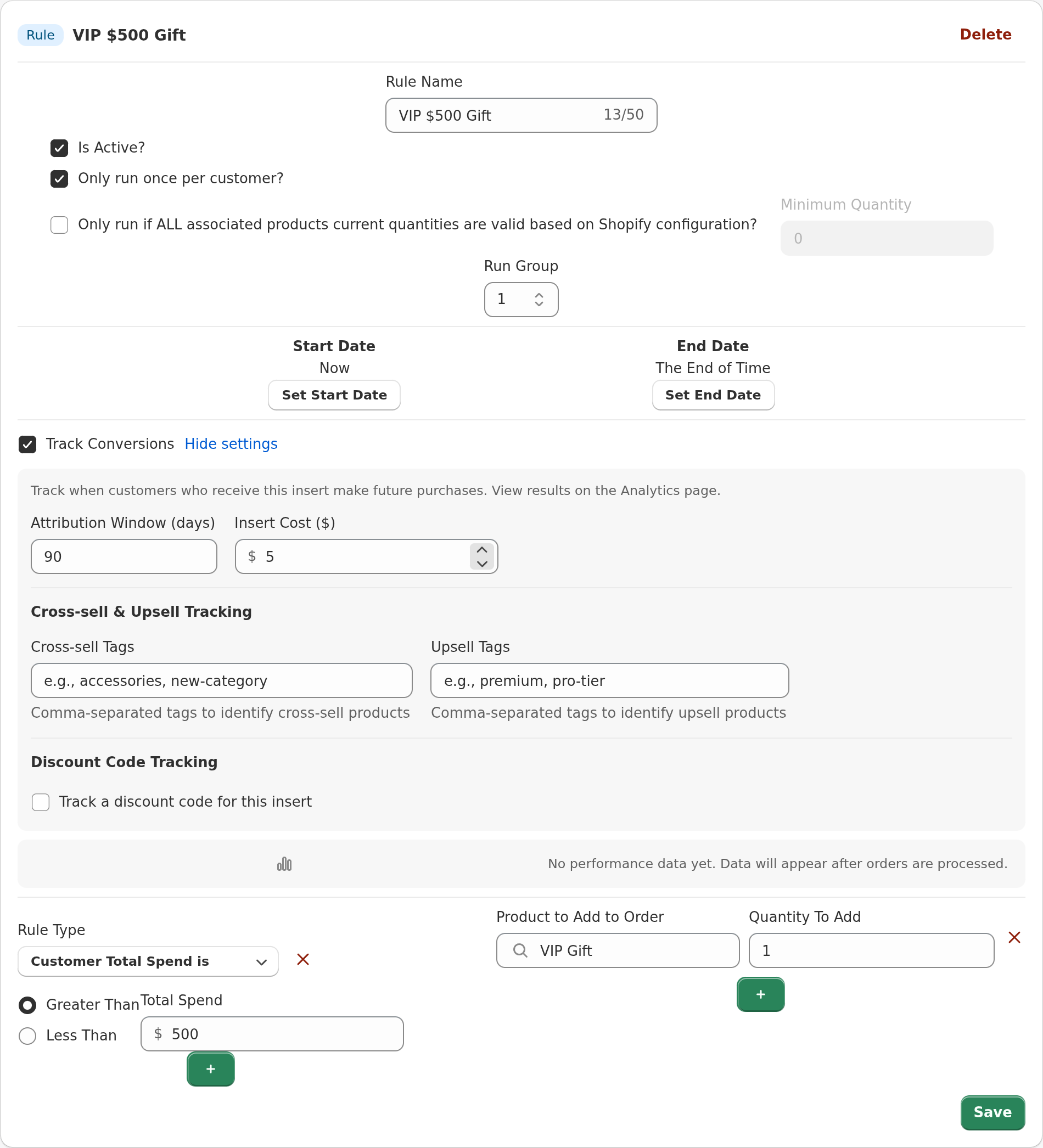 Configure VIP recognition rules to automatically send premium gifts to your best customers.
Implementation in Insertr
Each segment becomes a rule:
Rule 1: First Order Welcome
  Condition: Order Count = 1
  Insert: Thank You Card + $10 Discount
  Apply once per customer: Yes

Rule 2: Repeat Customer Sample
  Condition: Order Count >= 2
  Insert: New Product Sample
  Apply once per customer: No (every order)

Rule 3: VIP Gift
  Condition: Total Spend > $500
  Insert: Premium Gift Set
  Apply once per customer: Yes

Rule 4: Subscriber Milestone
  Condition: Subscription Order Count = 6
  Insert: 6-Month Anniversary Gift
  Apply once per customer: Yes
Measuring Post-Purchase Experience Quality
Leading Indicators
| Metric |
What It Measures |
Target |
| Support tickets per 100 orders |
Confusion/problems |
< 3 |
| Review rating average |
Product/experience satisfaction |
> 4.5 |
| Review completion rate |
Engagement after purchase |
> 10% |
| Unsubscribe rate (post-purchase emails) |
Email relevance |
< 0.5% |
Lagging Indicators
| Metric |
What It Measures |
Target |
| Repeat purchase rate |
Conversion to loyal customer |
> 25% |
| Time to second purchase |
Purchase velocity |
Decreasing |
| Customer lifetime value |
Total relationship value |
Increasing |
| Net Promoter Score |
Willingness to recommend |
> 50 |
Insert-Specific Metrics
| Metric |
Formula |
What It Tells You |
| Conversion rate |
Conversions ÷ Recipients |
Insert effectiveness |
| Revenue per recipient |
Revenue ÷ Recipients |
Value created |
| ROAS |
Revenue ÷ (Recipients × Cost) |
Return on investment |
| Segment comparison |
Rate by segment |
Where to invest more |
A/B Testing the Experience
Not sure what works? Test it.
What to Test
Insert type:
- Thank you card vs. discount card
- Sample A vs. Sample B
- Gift vs. discount
Insert content:
- Different discount amounts ($5 vs. $10 vs. 15%)
- Different expiration periods (7 days vs. 30 days)
- Different messaging (emotional vs. practical)
Experience elements:
- Box quality (standard vs. premium)
- Tissue paper (yes vs. no)
- Personal note (yes vs. no)
How to Test
- Define hypothesis: "A $10 discount will drive more repeat purchases than a thank you card alone"
- Create variants: 50% get discount card, 50% get thank you card only
- Run until significant: 100+ recipients per variant minimum
- Measure what matters: Conversion rate, revenue per recipient, ROAS
- Consider all metrics: Higher conversions but lower AOV? Factor in discount cost.
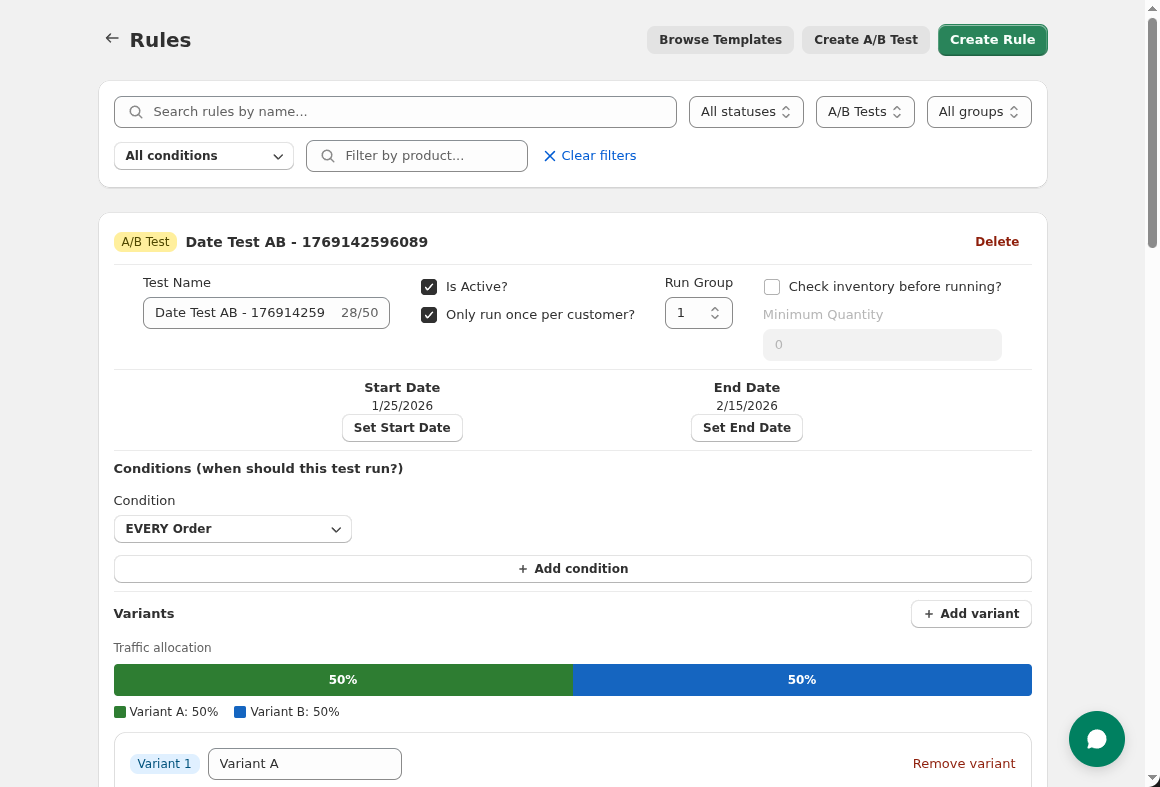 Create A/B tests to compare different insert strategies and measure which performs best.
Common Post-Purchase Mistakes
Mistake 1: Forgetting Post-Purchase Exists
Many brands optimize acquisition to death and ignore retention entirely.
Fix: Allocate specific resources to post-purchase. It has higher ROI than acquisition.
Mistake 2: Same Experience for Everyone
First-time buyer gets the same thing as a VIP. Feels impersonal.
Fix: Segment and personalize. Even two segments (new vs. returning) is better than one.
Mistake 3: Generic Physical Experience
Plain box, loose product, packing slip. Missed opportunity.
Fix: Add branded elements and inserts. The package is a marketing channel.
Mistake 4: Wrong Timing
Review request on delivery day (they haven't used it). Win-back email after 3 days (not enough time).
Fix: Map the customer journey and time communications appropriately.
Mistake 5: Over-Communication
Email every day. SMS blasts. Pop-ups on every page.
Fix: Coordinate channels. Respect attention. Quality over quantity.
Mistake 6: No Tracking
"We do post-purchase stuff but have no idea if it works."
Fix: Track everything. Attribution windows for inserts. Flow metrics for email.
Building Your Post-Purchase Playbook
Quick Wins (Implement This Week)
- Audit your confirmation email. Is it helpful? Personal? Clear?
- Add one physical insert. First-order thank you card is the obvious starting point.
- Check your packaging. Does it feel intentional or like an afterthought?
Medium-Term (Next Month)
- Create 2-3 customer segments. New, returning, VIP at minimum.
- Personalize inserts by segment. Different treatment for different value.
- Set up attribution tracking. Know which inserts drive returns.
Long-Term (Next Quarter)
- A/B test insert types. Optimize for what actually converts.
- Expand personalization. Product-specific, behavior-based inserts.
- Review metrics monthly. Repeat rate, LTV, ROAS by segment.
Make Every Delivery Count
The post-purchase experience isn't a cost center—it's a revenue driver.
Customers who have a great experience come back. Those who have a generic experience might not. The difference compounds over customer lifetime.
Physical inserts are the most direct way to elevate the experience. They arrive at the peak moment—unboxing—when customers are most receptive. And they can be personalized at scale through automation.
- Install Insertr to automate insert personalization
- Start with a first-order thank you to build the relationship
- Add VIP recognition to reward your best customers
- Measure and expand based on what converts
Your competitors send generic packages. You send memorable experiences. That's the difference.
Last updated: February 2026 | Author: Tom McGee, Founder of Insertr
About the Author: Tom McGee is the founder of Insertr and a former Senior Software Engineer at both Shopify and ShipBob. At ShipBob, he spent nearly 4 years building warehouse management software for packing flows—giving him firsthand experience with how 3PLs handle physical inserts. He also founded Cool Steeper Club, a curated cold brew tea subscription box, where he used package inserts to drive subscriber retention.
Related Guides