The marketing funnel doesn't end at checkout.
Most e-commerce brands obsess over customer acquisition—paid ads, SEO, influencer campaigns. They spend 5x more acquiring a new customer than keeping an existing one. Then they wonder why lifetime value stays flat.
Post-purchase marketing flips that equation. It's everything that happens after the order is placed: the transactional emails, the unboxing experience, the follow-up outreach. Done well, it transforms one-time buyers into repeat customers.
This guide covers post-purchase marketing comprehensively—but with a specific focus on the channel most brands ignore: the package itself.
Post-purchase marketing is any marketing activity that targets customers after they've made a purchase. The goal is to:
The post-purchase period is uniquely valuable because you're marketing to people who already trust you enough to buy. The hardest conversion—stranger to customer—is done. Now you're working with a warm audience.
Most brands focus on digital channels. Here's the landscape:
How it works: Automated sequences triggered by purchase—order confirmations, shipping updates, review requests, reorder reminders.
Pros:
Cons:
When to use: Always. Email is table stakes for post-purchase communication.
How it works: Text messages for shipping updates, flash sales, and urgent offers.
Pros:
Cons:
When to use: Sparingly and with clear value (shipping updates, flash sales). Don't spam.
How it works: Paid ads on social platforms targeting past purchasers.
Pros:
Cons:
When to use: For specific campaigns (product launches, seasonal sales) but not as primary retention channel.
How it works: Physical items added to orders—thank you cards, samples, discount cards, promotional flyers—that arrive with the customer's purchase.
Open rate: 100%. Every customer opens their package.
Pros:
Cons:
When to use: As a core pillar of your post-purchase strategy, not an afterthought.
Let's do the math.
Assume you have 1,000 customers and want to reach them post-purchase:
| Channel | Reach | Engagement | Action |
|---|---|---|---|
| 250 opened (25%) | 50 clicked (20% of opens) | 5 purchased (10% conversion) | |
| Physical Insert | 1,000 saw it (100%) | 300 engaged (30% read/kept) | 15 purchased (5% conversion) |
Even with lower conversion rates from engagement to purchase, physical inserts reach 3x more customers effectively because there's no open-rate bottleneck.
And the engagement quality is different:
That tactile moment matters. The customer is already in "receiving mode"—they're opening a package they're excited about. Your insert arrives at the perfect psychological moment.
Research on unboxing experiences shows that the moment of package opening triggers dopamine release—the anticipation and reward circuit. This is why unboxing videos exist. This is why Apple designs their packaging so carefully.
Your insert arrives at this exact moment:
Compare to email:
The context is completely different. One is a moment of joy; the other is a chore.
Here's what actually works:
| Insert Type | Why It Works | Example |
|---|---|---|
| Discount card | Immediate incentive with urgency | "$10 off your next order - expires in 14 days" |
| Reorder reminder magnet | Stays visible, triggers when needed | Fridge magnet: "Time to reorder? Use code REORDER15" |
| Subscription upsell card | Convert one-time to recurring | "Subscribe & Save 15% on every order" |
Best for: Consumable products, subscription businesses, products with predictable reorder cycles.
| Insert Type | Why It Works | Example |
|---|---|---|
| Product sample | Try before they buy | Coffee sample in a tea order |
| Category preview card | Introduce without commitment | "Did you know we also make...?" |
| Bundle offer | Discount on complementary purchase | "Add [accessory] to your next order - 20% off" |
Best for: Brands with multiple product lines or categories.
| Insert Type | Why It Works | Example |
|---|---|---|
| Handwritten-style thank you | Personal touch at scale | "Thanks for being customer #4,521!" |
| Founder story postcard | Brand connection | Photo + message from founder |
| VIP recognition gift | Rewards best customers | Premium gift for $500+ lifetime spend |
| Milestone card | Celebrates relationship | "Happy 1-year anniversary as a customer!" |
Best for: All brands. Loyalty inserts build the relationship regardless of what you sell.
| Insert Type | Why It Works | Example |
|---|---|---|
| Review request card | QR code makes it easy | "Love it? Leave a review" with QR to review page |
| Social share prompt | Leverages unboxing moment | "Share your unboxing @yourbrand for a chance to win" |
| Photo submission card | Structured UGC collection | "Send us a photo using [product] for 10% off" |
Best for: New products, brands building social proof, DTC brands on social platforms.
Here's where most brands fail with inserts: they send the same thing to everyone.
Imagine a customer who:
Do they need a "$5 off first subscription" card? No. It's a wasted insert and might even feel insulting.
Targeted inserts outperform generic inserts by 3-4x because they're relevant.
| Segment | What They Need | Insert Strategy |
|---|---|---|
| First-time buyer | Welcome, reassurance, reason to return | Thank you card + small discount for next order |
| Second order | Validation, deeper engagement | "You're back! Here's something special" |
| Repeat customer (3+) | Recognition, loyalty rewards | Exclusive sample or upgraded gift |
| VIP ($500+ LTV) | Premium treatment | High-value gift, handwritten note |
| Lapsed (no order in 90 days) | Win-back incentive | Stronger discount, "we miss you" |
| Subscriber | Retention, appreciation | Subscriber-only perks, milestone gifts |
| Non-subscriber | Conversion to subscription | "Subscribe & save" with clear value prop |
| Context | Insert Strategy |
|---|---|
| High-value order ($150+) | Premium gift, elevated thank you |
| Order contains [category] | Cross-sell sample from complementary category |
| Order uses discount code | Don't stack more discounts; focus on relationship |
| First order to address | Premium welcome (protects against reseller abuse) |
| Ships to [country] | Localized messaging and relevant offers |
| Customer speaks [language] | Translated inserts |
This targeting is impossible with manual processes. It requires automation—which is exactly what Insertr provides.
Manual insert programs don't scale:
Automation solves this by making inserts work like email:
 Automated rules evaluate every order against your conditions and add qualifying inserts.
Here's the key insight: inserts added as line items work with any fulfillment system.
Whether you use ShipBob, ShipHero, Deliverr, or your own warehouse—if they can read Shopify orders, they can fulfill your inserts. No custom integration. No special per-order instructions. No additional fulfillment fees (beyond the physical cost of the insert).
The insert appears as:
Line 1: Blue Widget ($29.99)
Line 2: Thank You Card ($0.00)
Your 3PL picks both items. Customer receives both. Done.
"How do I know if this is working?"
The biggest objection to insert marketing is measurement. You can't click a thank you card. But you can measure:
| Metric | How to Measure | What It Tells You |
|---|---|---|
| Recipients | Count of customers who received insert | Your sample size |
| Conversions | Recipients who placed a follow-up order | Did it drive action? |
| Conversion Rate | Conversions ÷ Recipients | Effectiveness |
| Revenue | Total revenue from conversion orders | Business impact |
| ROAS | Revenue ÷ (Recipients × Insert Cost) | Return on investment |
Physical inserts don't convert immediately. A customer might:
Your attribution window should capture this delayed conversion:
| Product Type | Recommended Window |
|---|---|
| Consumables (30-day use) | 45-60 days |
| Apparel/accessories | 60-90 days |
| High-ticket items | 90-120 days |
For precise measurement, use unique discount codes on inserts:
THANKYOU15This gives you hard numbers without attribution modeling.
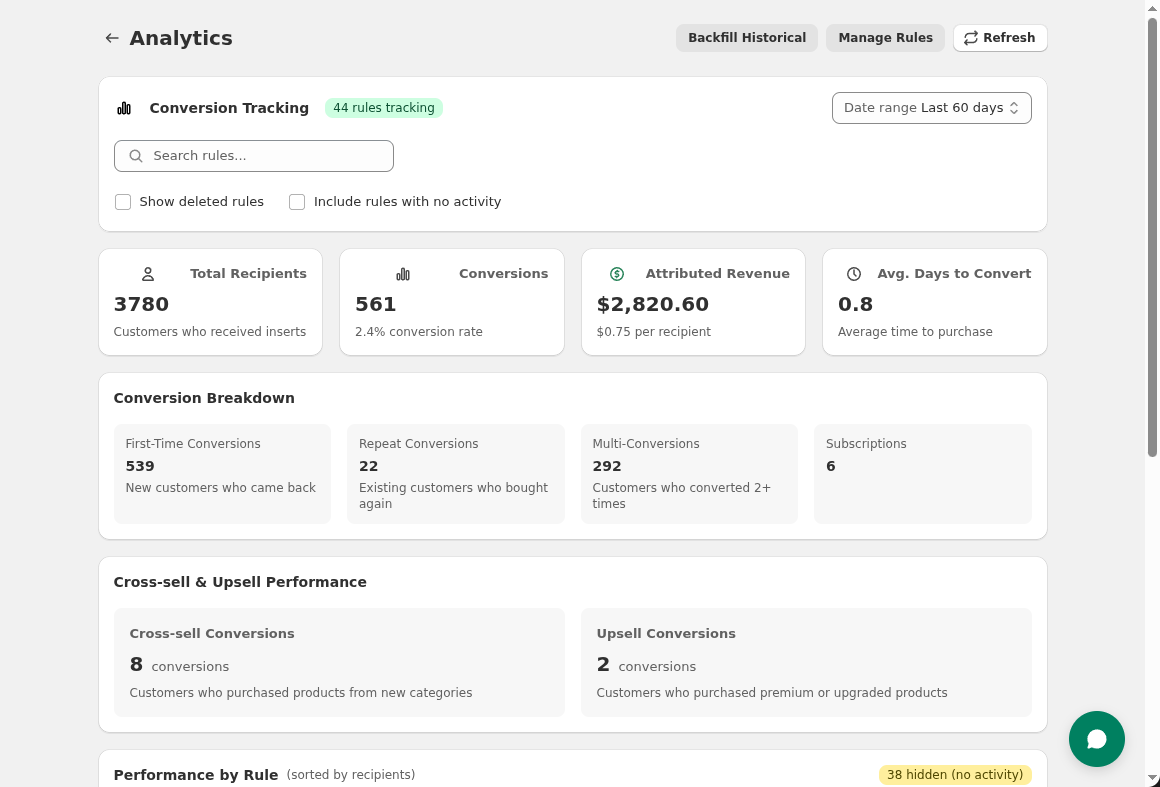 Track recipients, conversions, and ROAS for each insert rule.
Here's how to build an effective insert program from scratch:
Start with one insert: A first-order thank you card.
Set up tracking:
Measure baseline: Run for 2-4 weeks to establish conversion rates.
Add targeted inserts:
Compare performance: Which segments convert best? Double down there.
A/B test insert types:
Expand to advanced targeting:
Calculate and report ROI: Monthly review of:
| Goal | Insert | Trigger |
|---|---|---|
| Reorder | Fridge magnet with reorder QR code | First order of consumable |
| Cross-sell | Complementary flavor sample | Buys one flavor, hasn't tried another |
| Recipe engagement | Recipe card featuring their purchase | Orders cooking ingredients |
| Subscription | "Never run out" subscription offer | 2nd order of same product |
| Goal | Insert | Trigger |
|---|---|---|
| Full-size purchase | Deluxe sample of bestseller | First order |
| Routine expansion | Complementary product sample | Buys cleanser, hasn't bought moisturizer |
| VIP treatment | Premium gift set | Lifetime spend > $300 |
| Education | How-to card for product | Orders product with learning curve |
| Goal | Insert | Trigger |
|---|---|---|
| Return reduction | Care instruction card | Orders delicate items |
| Complete the look | Styling card with outfit suggestions | Orders single item |
| Seasonal prep | New collection preview | Orders summer items (send winter preview) |
| Loyalty | VIP access card to sales | Order count > 5 |
| Goal | Insert | Trigger |
|---|---|---|
| Retention | "Coming next month" preview | Every box |
| Milestone | Anniversary gift | 6th, 12th box |
| Engagement | Community invite card | First box |
| Upgrade | Premium tier offer | 3rd box |
| Referral | "Give $20, Get $20" referral card | Every box |
Generic inserts feel generic. A first-time customer and a VIP should get different treatment.
Fix: Use targeting rules. Even two segments (new vs. returning) is better than one.
"We've always done inserts" but no one knows if they work.
Fix: Set up attribution tracking from day one. Even basic metrics (recipients, conversions) prove value.
Customer uses a 20% coupon. Order includes a 15% discount insert. Now they expect 35% off.
Fix: Exclude orders that already used a discount from receiving discount inserts.
Customer receives first-order thank you. Then they receive first-order thank you again. And again.
Fix: Use "apply once per customer" settings for welcome-type inserts.
French customer receives English thank you card. Feels impersonal.
Fix: Use language and country targeting for localized inserts.
Let's build a realistic scenario:
Assumptions:
First-Order Thank You Program:
Compare to paid acquisition:
Inserts deliver 4x better ROAS than acquiring new customers.
And that's just one simple rule. Add VIP gifts, cross-sell samples, and subscription upsells—each with their own ROI contribution.
Ready to add automated inserts to your post-purchase marketing?
Your packages are already being delivered. Make each one a marketing opportunity.
Last updated: January 2026 | Author: Tom McGee, Founder of Insertr
About the Author: Tom McGee is the founder of Insertr and a former Senior Software Engineer at both Shopify and ShipBob. At ShipBob, he spent nearly 4 years building warehouse management software for packing flows—giving him firsthand experience with how 3PLs handle physical inserts. He also founded Cool Steeper Club, a curated cold brew tea subscription box, where he used package inserts to drive subscriber retention.