When brands think "packaging marketing," they usually picture custom printed boxes. Tissue paper with their logo. Branded tape.
That's all fine. But it's expensive, it's fixed, and you can't personalize it per customer.
The real opportunity in packaging marketing is what goes inside the box: physical inserts that arrive with every order. These are the elements that drive action—repeat purchases, subscriptions, reviews, referrals.
This guide focuses on insert marketing: what it is, why it outperforms other channels, and how to do it effectively.
Packaging marketing uses the physical package—everything involved in delivering your product—as a marketing touchpoint. It includes:
Outer packaging:
Inner packaging:
Inserts (our focus):
| Element | Cost | Personalization | Call-to-Action | Measurable |
|---|---|---|---|---|
| Custom box | $2-10/box | None (fixed print) | Weak (just brand) | No |
| Tissue paper | $0.25-1/order | None | None | No |
| Thank you card | $0.15-0.50/card | Per customer | Strong | Yes |
| Sample | $0.50-3/sample | Per customer | Strong | Yes |
| Discount card | $0.15-0.50/card | Per customer | Strong | Yes |
Custom boxes build brand. But inserts drive action.
A beautiful box doesn't ask for anything. An insert can:
And because inserts are added per-order, you can target them. First-time buyers get a different insert than repeat customers. VIPs get different treatment than one-time purchasers.
Let's compare cost-effectiveness:
Email Marketing:
Paid Social Retargeting:
Package Inserts:
While inserts have a higher unit cost than email, their 100% delivery rate makes them competitive. And the context is incomparable—your email competes with 50+ others in the inbox; your insert has zero competition inside the box.
Custom Printed Boxes:
Targeted Inserts:
A brand spending $5/box on custom packaging could instead use a $1 generic box + $0.50 insert and invest the remaining $3.50 in higher-value inserts for their best customers.
What: Simple card expressing gratitude for the order.
Best for: Building relationship, reducing buyer's remorse, humanizing the brand.
Examples:
Cost: $0.15-0.50/card
ROI mechanism: Indirect—builds loyalty that manifests in retention.
What: Physical coupon for a future purchase.
Best for: Driving immediate repeat purchases, reactivating lapsed customers.
Examples:
Cost: $0.15-0.50/card + discount cost when redeemed
ROI mechanism: Direct—track redemptions and calculate revenue per card.
Pro tip: Use unique discount codes or time-limited offers to create urgency.
What: Small or trial-size versions of products the customer hasn't tried.
Best for: Cross-selling, new product introduction, category expansion.
Examples:
Cost: $0.50-5/sample (varies widely by product)
ROI mechanism: Track whether sample recipients convert to full-size purchases.
What: Single-sheet promotional material for campaigns or launches.
Best for: New product announcements, seasonal campaigns, sale promotions.
Examples:
Cost: $0.10-0.25/flyer
ROI mechanism: Track campaign conversions from recipients.
What: Card with referral code/link for the customer to share.
Best for: Word-of-mouth growth, network effects.
Examples:
Cost: $0.15-0.50/card + referral bonus when redeemed
ROI mechanism: Track referral conversions and calculate cost per referred customer.
What: Practical items with your branding that customers keep.
Best for: Long-term brand visibility, creating value beyond the product.
Examples:
Cost: $0.25-2/item
ROI mechanism: Harder to measure directly, but creates persistent brand touchpoints.
The challenge with inserts: personalization at scale.
Manual processes don't work:
This is why most brands default to one-size-fits-all inserts—and miss the opportunity for targeting.
Insertr automates personalized inserts by:
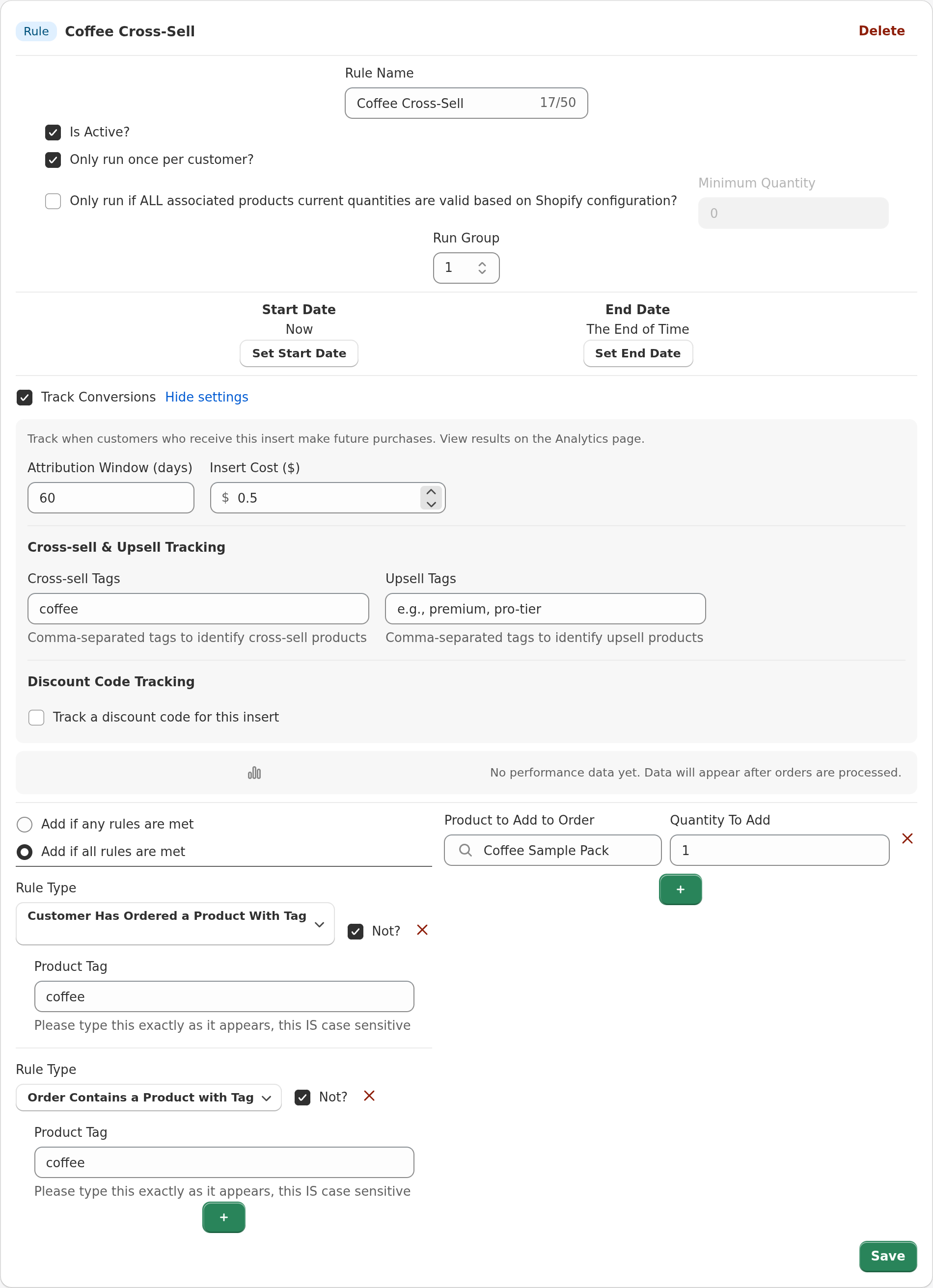 Rules can target based on 17+ conditions including order value, customer tags, products purchased, and more.
Because inserts become regular line items:
| Rule Type | Example Use |
|---|---|
| Every Order | Universal insert (brand story) |
| Order Value > X | Free gift threshold |
| Order Value < X | Upsell to reach threshold |
| Customer Order Count | First order thank you |
| Customer Total Spend | VIP recognition |
| Customer Tag | Segment-specific inserts |
| Product Tag | Product-specific cross-sells |
| Contains Product | Accessory promotion |
| Has Ordered Product | Win-back for specific product |
| Customer Has Subscription | Subscriber vs. non-subscriber |
| Subscription Order Count | Subscriber milestone gifts |
| Shipping Country | Localized inserts |
| Customer Language | Translated materials |
| Distance from Location | Local store invitations |
| Order Discount Code | Influencer campaign thank you |
| First Order to Address | Prevent reseller abuse |
Challenge: Product discovery—customers stick to what they know.
Insert Strategy:
| Trigger | Insert | Goal |
|---|---|---|
| First order | Bestseller sample | Expand routine |
| Bought cleanser, not moisturizer | Moisturizer sample | Complete routine |
| VIP ($500+ spend) | Deluxe sample set | Premium treatment |
| Reorder same product 3x | "Try our subscription" card | Convert to subscription |
Challenge: Reorder timing—customers forget or switch brands.
Insert Strategy:
| Trigger | Insert | Goal |
|---|---|---|
| First order consumable | Reorder reminder magnet | Stay visible |
| Bought flavor A | Flavor B sample | Expand variety |
| Single purchase | Subscription upsell card | Convert to recurring |
| High-value order | Recipe cards | Increase engagement |
Challenge: Low repeat purchase frequency, high return rate.
Insert Strategy:
| Trigger | Insert | Goal |
|---|---|---|
| First order | Care instruction card | Reduce returns |
| Bought single item | Styling/outfit card | Inspire additional purchases |
| Repeat customer | VIP early access card | Reward loyalty |
| Bought summer items | Winter preview | Capture seasonal spend |
Challenge: Churn—keeping subscribers engaged month over month.
Insert Strategy:
| Trigger | Insert | Goal |
|---|---|---|
| First box | Welcome + how to get most value | Set expectations |
| Box 3 | "Coming next month" preview | Build anticipation |
| Box 6 | 6-month milestone gift | Celebrate retention |
| Every box | Referral card | Growth through WOM |
| Metric | Formula | What It Means |
|---|---|---|
| Recipients | Count of customers who received insert | Sample size |
| Conversions | Recipients who placed a follow-up order | Success count |
| Conversion Rate | Conversions ÷ Recipients | Effectiveness % |
| Revenue | Sum of conversion order totals | Dollar impact |
| Revenue per Recipient | Revenue ÷ Recipients | Value per insert |
| AOV | Revenue ÷ Conversions | Buyer quality |
| ROAS | Revenue ÷ (Recipients × Insert Cost) | Return multiple |
Not all conversions happen immediately. A customer might:
Set attribution windows based on your product:
| Product Type | Window |
|---|---|
| Consumables (coffee, supplements) | 45-60 days |
| Skincare/beauty | 60-90 days |
| Apparel | 90 days |
| High-ticket items | 120 days |
For precise measurement:
THANKYOU15Non-recipient redemptions indicate code sharing—valuable word-of-mouth but different attribution.
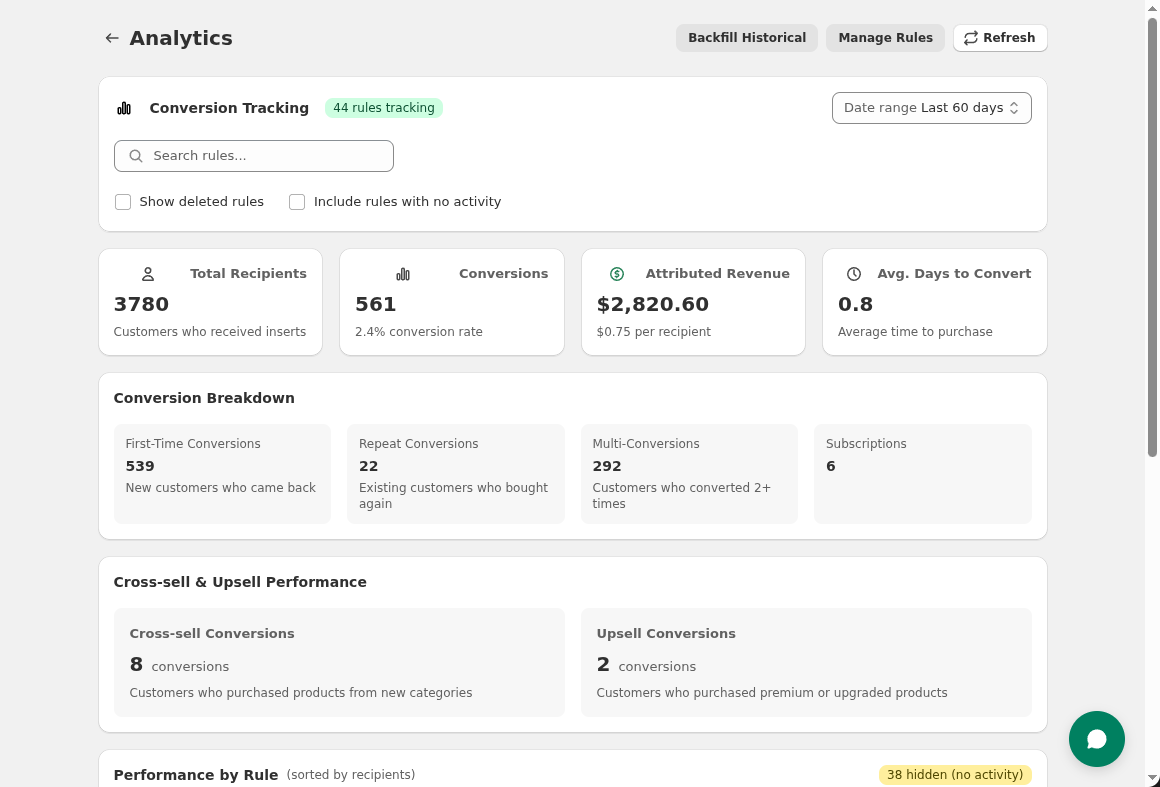 Track ROAS (Return on Ad Spend) for each insert rule to understand ROI.
Create insert product in Shopify
Set up first rule in Insertr
Enable tracking
Let the rule run. You need:
Don't optimize yet—just collect data.
Review metrics:
If positive, add more rules:
Q: Won't customers be annoyed by inserts? A: Research shows customers expect and appreciate thoughtful packaging touches. The key is relevance—a welcome thank you card feels appropriate; a spam-y flyer in every order feels cheap.
Q: What about insert weight and shipping costs? A: Cards weigh 5-10 grams. A standard USPS First Class package can be up to 15.99 oz. You'd need 150+ cards to add meaningful shipping cost.
Q: How do I get my 3PL to pack inserts? A: That's the beauty—you don't need to. When inserts appear as order line items, your 3PL picks them like any other product. No special instructions needed.
Q: Should I use inserts or email? A: Both. They serve different moments. Email for immediate follow-up (order confirmation, shipping). Inserts for the unboxing moment when customer excitement peaks.
Q: What's a good conversion rate for inserts? A: Varies by insert type and product. 5-15% for first-order thank you cards is solid. Discount cards can hit 15-25%. Samples targeting the right customer can exceed 20%.
Your packages are already being delivered. Every one is an opportunity.
Start with a simple thank you card. Build from there. The infrastructure—automation, targeting, tracking—makes what used to be impossible completely manageable.
Turn packaging into marketing.
Last updated: January 2026 | Author: Tom McGee, Founder of Insertr
About the Author: Tom McGee is the founder of Insertr and a former Senior Software Engineer at both Shopify and ShipBob. At ShipBob, he spent nearly 4 years building warehouse management software for packing flows—giving him firsthand experience with how 3PLs handle physical inserts. He also founded Cool Steeper Club, a curated cold brew tea subscription box, where he used package inserts to drive subscriber retention.