The marketing funnel ends at checkout.
Or at least, that's how most brands treat it. They spend months optimizing ads, email sequences, and landing pages to convert visitors into customers. Then the order is placed and... silence. Maybe an automated email sequence.
But the customer's journey is just beginning. What happens after the purchase determines whether they become a one-time buyer or a lifetime customer.
This guide explores post-purchase psychology: the mental states customers experience, the moments that matter, and how to influence behavior at each stage.
The moment after a purchase is psychologically complex.
When someone makes a buying decision—especially for a significant purchase—they experience cognitive dissonance. They've committed resources (money) to one option and foregone alternatives. Their brain seeks confirmation that they made the right choice.
This manifests as:
The brands that win turn this anxiety into confidence. The brands that lose let doubt fester.
Customer emotions follow a predictable pattern:
Stage 1: Post-Purchase Glow (0-2 hours)
Stage 2: Anticipation Phase (shipping period)
Stage 3: Unboxing Moment (delivery)
Stage 4: First Use (hours to days)
Stage 5: Integration Phase (1-4 weeks)
Stage 6: Decision Window (2-8 weeks)
Neuroscience research on reward anticipation shows that the moment of receiving an expected reward produces a significant dopamine response. This is why unboxing videos have billions of views—people are literally experiencing a neurochemical high watching someone else open a package.
For your customer:
At this exact moment, customers are:
This is why physical inserts are so effective. They arrive at the moment of maximum positive emotion, not in an inbox alongside 50 other messages.
What happens: Customer receives order confirmation email.
Psychology: Relief that order went through, beginning of anticipation.
What most brands do: Generic automated email with order details.
What effective brands do:
Insert opportunity: None yet—order just placed.
What happens: Order ships, tracking becomes available.
Psychology: Anticipation intensifies. Tracking obsession begins.
What most brands do: Automated "Your order has shipped" email.
What effective brands do:
Insert opportunity: None yet—product in transit.
What happens: Package arrives. Customer opens it.
Psychology: Highest emotional moment. Dopamine spike. Expectations meet reality.
This is where physical inserts arrive.
The customer is:
Insert opportunity: Maximum.
| Goal | Insert | Psychology |
|---|---|---|
| Reduce remorse | Thank you card | "Good choice—we appreciate you" |
| Build relationship | Founder note | Personal connection with brand |
| Encourage engagement | Usage tips card | Help them succeed with product |
| Drive next purchase | Discount card | Incentive at peak positive moment |
| Cross-sell | Product sample | Try something new while happy |
| Generate review | Review request card | Ask while satisfaction is high |
What happens: Customer uses the product.
Psychology: Satisfaction or disappointment. Expectations calibrate to reality.
What most brands do: Nothing. Maybe a "How was it?" email weeks later.
What effective brands do:
Insert connection: Tips cards from the unboxing can help ensure successful first use.
What happens: Initial excitement fades. Product becomes routine or forgotten.
Psychology: Habit formation (or not). Brand salience decreases.
What most brands do: Dump into general email list. Send sale announcements.
What effective brands do:
Insert connection: Reorder reminder magnets from unboxing stay visible. Discount cards remind of next purchase opportunity.
What happens: Customer needs to reorder (consumables) or considers another purchase.
Psychology: Brand consideration set. Influenced by total experience.
This is when insert ROI materializes.
The customer who received:
Attribution windows in Insertr capture this moment.
Industry benchmarks for time to second purchase:
| Industry | Average Days to 2nd Purchase | Optimal Insert Attribution Window |
|---|---|---|
| Coffee/Tea | 25-35 days | 45 days |
| Supplements | 30-45 days | 60 days |
| Skincare | 45-60 days | 75 days |
| Apparel | 60-90 days | 90 days |
| Home goods | 90-180 days | 120 days |
Implication: Your insert needs to stay with the customer long enough to influence their next purchase decision. A card on their desk, a magnet on their fridge.
Without reinforcement, customers forget:
Physical inserts combat this by:
A customer opens their wallet to buy something online, sees your discount card. You're back in their consideration set.
Goal: Turn one-time buyer into repeat customer.
Insert strategy:
| Component | What | Why |
|---|---|---|
| Thank you card | Handwritten-style appreciation | Builds emotional connection |
| First order discount | "$10 off your next order" (14-day expiration) | Creates urgency for return |
| Product tips card | How to get the most from their purchase | Ensures satisfaction |
Trigger: Customer Order Count = 1
Expected outcome: 8-15% of first-time buyers place second order within 45 days.
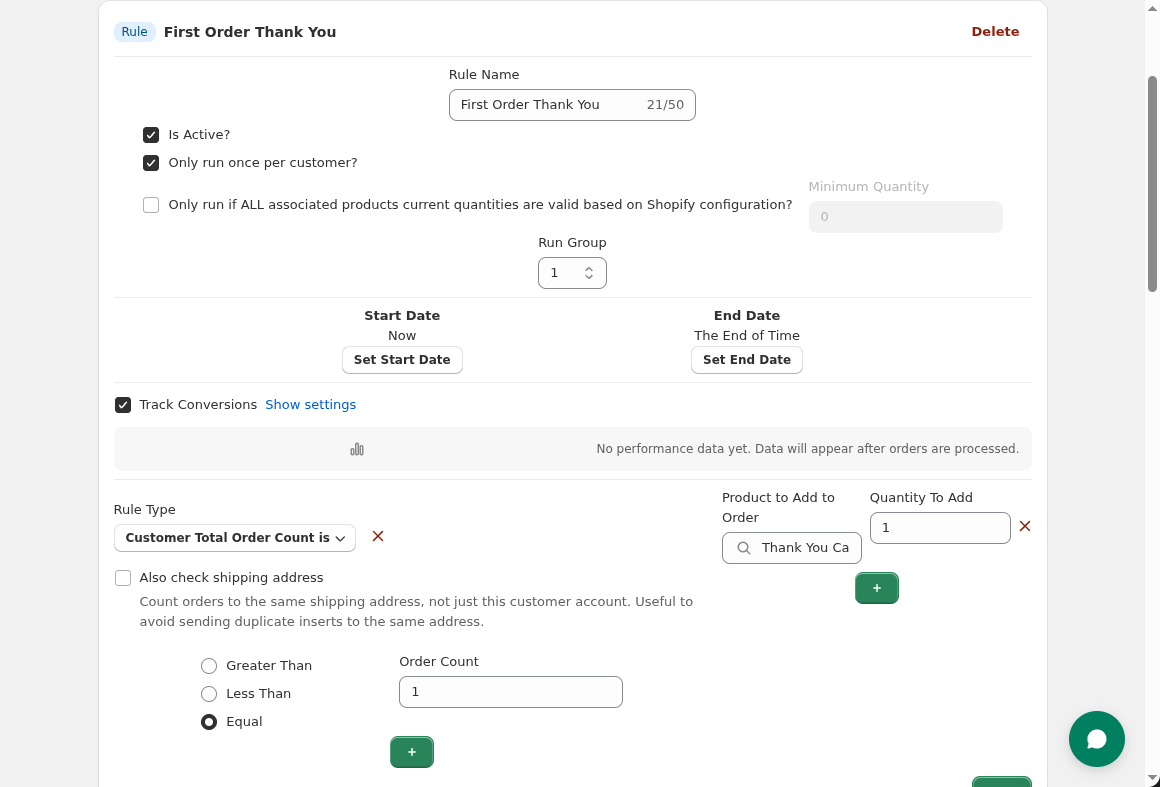 Configure a first-order welcome insert to build the relationship from day one.
Goal: Maximize satisfaction and usage for specific products.
Insert strategy:
| Product Type | Insert | Why |
|---|---|---|
| Consumable (coffee) | Recipe/pairing cards | Increase usage occasions |
| Technical (electronics) | Quick start guide | Reduce frustration |
| Care-intensive (clothing) | Care instructions | Prevent damage/returns |
| Subscription | "What's in your box" card | Build anticipation |
Trigger: Order contains [specific product] or Product Tag = [type]
Expected outcome: Reduced returns, higher satisfaction, more repeat purchases.
Goal: Reward and recognize loyal customers.
Insert strategy:
| Milestone | Insert | Why |
|---|---|---|
| 3rd order | Small thank you gift | Recognition builds loyalty |
| $200 lifetime spend | VIP status card | Exclusivity feeling |
| 6th subscription box | Anniversary gift | Celebrate retention |
| 1 year as customer | Handwritten note | Personal appreciation |
Trigger: Order Count = 3, Total Spend > $200, Subscription Order Count = 6
Expected outcome: Reduced churn, increased LTV, brand advocates.
Goal: Prompt reorder at the right time.
Insert strategy:
| Product | Insert | Why |
|---|---|---|
| 30-day supply | Fridge magnet: "Time to reorder?" | Visible reminder |
| Consumable | QR code card to quick reorder | Reduce friction |
| Any | Subscription upsell card | Convert to recurring |
Trigger: Product Tag = "consumable"
Expected outcome: Shorter time between purchases, higher reorder rate.
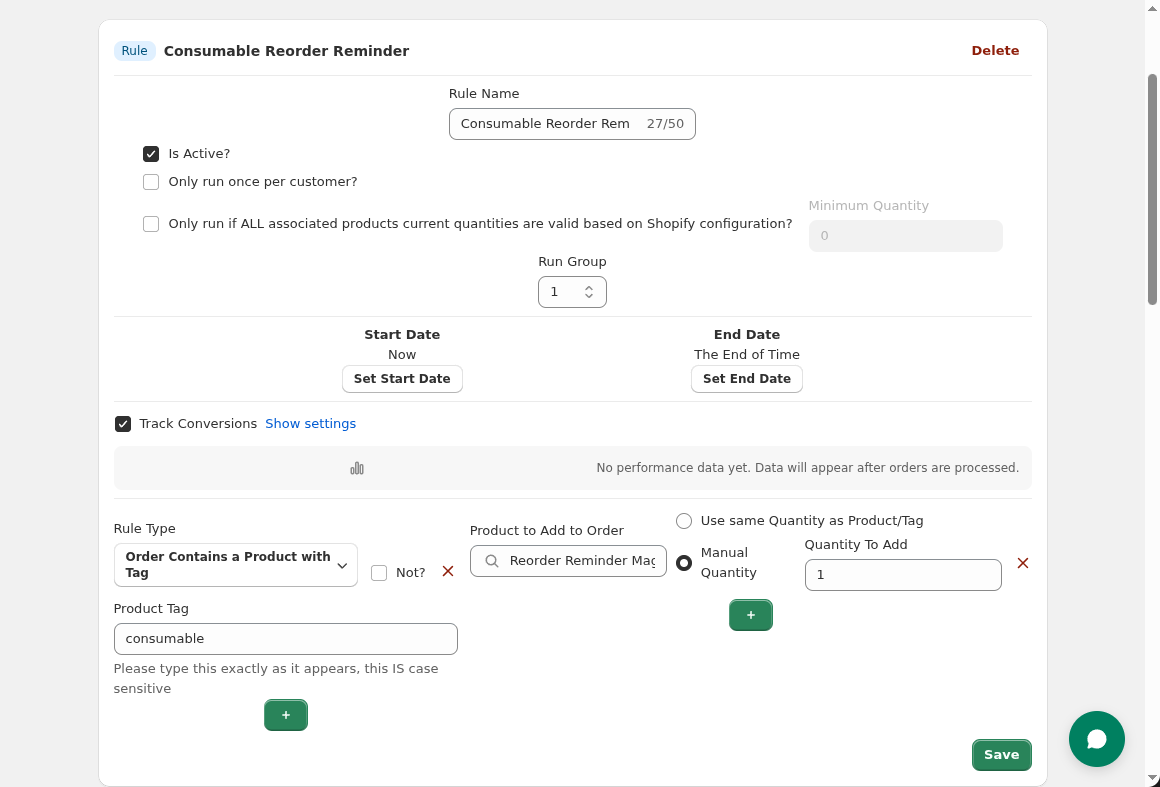 Target consumable products with reorder reminders to reduce time between purchases.
Goal: Treat different customers appropriately.
| Segment | Identification | Insert Strategy | Why |
|---|---|---|---|
| New customer | Order Count = 1 | Welcome + discount | Build relationship |
| Returning | Order Count 2-5 | Thank you + sample | Reward and expand |
| VIP | Total Spend > $500 | Premium gift | Recognize value |
| Subscriber | Has Subscription = Yes | Subscriber perks | Retention |
| Non-subscriber | Has Subscription = No | Subscription offer | Conversion |
| At-risk | Days since last order > 90 | Win-back discount | Reactivation |
Physical inserts have a unique timing advantage: they arrive at the unboxing moment.
Compare to other channels:
| Channel | When Customer Sees It | Emotional State | Competition |
|---|---|---|---|
| Checking inbox | Neutral/task-oriented | 50+ other emails | |
| SMS | Phone notification | Interrupted | Other notifications |
| Social ad | Scrolling | Distracted | Endless content |
| Package insert | Opening package | Peak positive emotion | Nothing |
This timing can't be replicated digitally. Email can't arrive at the unboxing moment. Only physical inserts do.
How do you know if your inserts are influencing post-purchase behavior?
| Metric | Baseline (no insert) | With Insert | Improvement |
|---|---|---|---|
| 45-day repeat purchase rate | 8% | 12% | +50% |
| Days to second purchase | 45 | 32 | -29% |
| Average order value (repeat) | $55 | $62 | +13% |
| Subscription conversion rate | 3% | 7% | +133% |
Test different approaches:
| Test | Variant A | Variant B | Measure |
|---|---|---|---|
| Insert vs. none | Thank you card | No insert | Conversion lift |
| Discount vs. relationship | $10 off card | Thank you card | Conversion rate + AOV |
| Sample type | Sample A | Sample B | Full-size conversion |
| Urgency | 7-day expiration | 30-day expiration | Conversion rate |
Q: How long do inserts influence behavior? A: Depends on the insert. A card might be discarded in a week; a fridge magnet might stay for months. Time-limited offers create urgency; relationship-building inserts create long-term affinity.
Q: What if the first use experience is negative? A: Inserts can help here too. A "Questions? Here's how to reach us" card reduces frustration. A tips card prevents user error. The unboxing moment insert can set expectations appropriately.
Q: Do inserts work for all products? A: Yes, but the strategy differs. Consumables benefit from reorder reminders. High-ticket items benefit from relationship building and care instructions. Impulse purchases benefit from validation.
Q: How do I know which moment to target? A: Start with the unboxing moment (that's where physical inserts naturally appear). Your insert's goal determines its content—a discount card targets the repeat purchase decision; a thank you card targets the immediate post-purchase emotions.
Post-purchase behavior isn't random. Customers go through predictable stages, face predictable emotions, and make decisions at predictable times.
By understanding this journey, you can:
Physical inserts are uniquely positioned for this because they arrive at the peak emotional moment—the unboxing—when customers are most receptive.
Start with a simple first-order thank you card. Measure its impact on repeat purchases. Build from there.
Install Insertr and turn customer psychology into customer loyalty.
Last updated: January 2026 | Author: Tom McGee, Founder of Insertr
About the Author: Tom McGee is the founder of Insertr and a former Senior Software Engineer at both Shopify and ShipBob. At ShipBob, he spent nearly 4 years building warehouse management software for packing flows—giving him firsthand experience with how 3PLs handle physical inserts. He also founded Cool Steeper Club, a curated cold brew tea subscription box, where he used package inserts to drive subscriber retention.